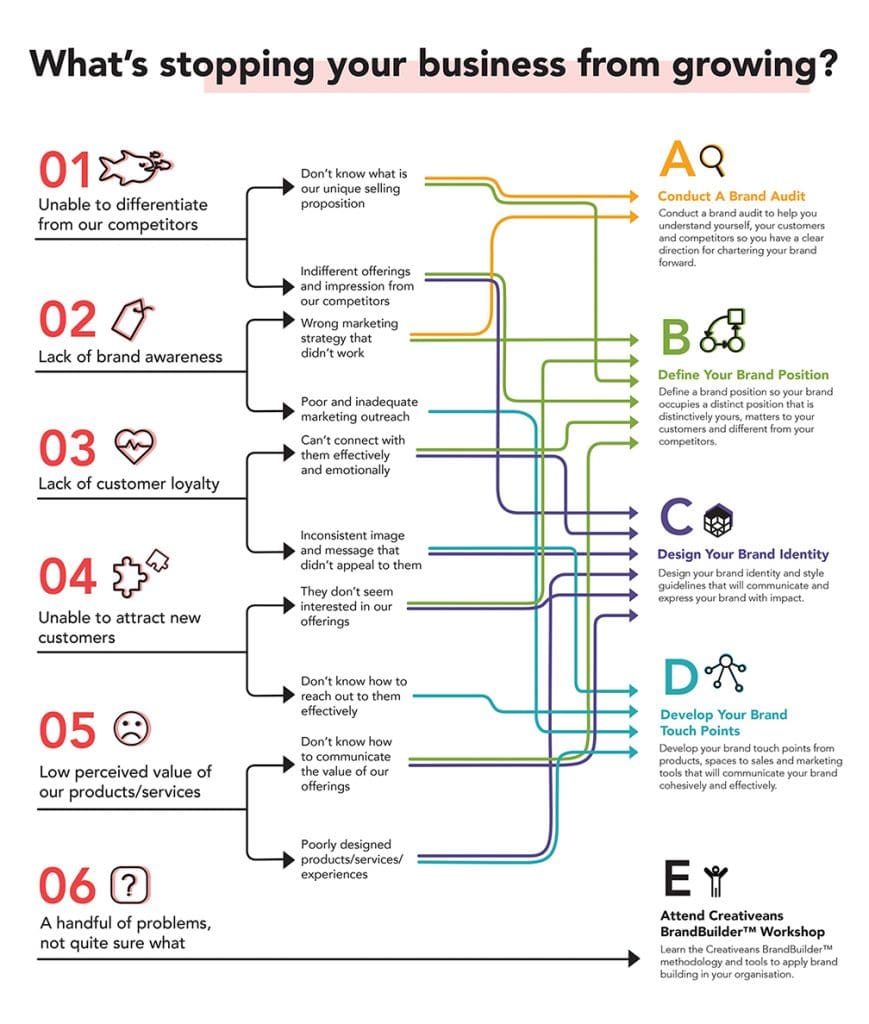
 Every business reaches a point where growth begins to slow. Sales plateau, customer acquisition becomes more expensive, competitors seem to move ahead faster, and every new marketing campaign delivers diminishing returns.
Many business owners immediately blame the economy, increasing competition, or changes in customer behaviour. While these external factors certainly play a role, they are rarely the root cause.
More often than not, slow business growth is the result of internal challenges that have gradually developed over time. These issues can range from unclear positioning and inconsistent branding to outdated business strategies and operational bottlenecks. Research consistently shows that sustainable growth depends not only on acquiring more customers but also on building strong systems, a differentiated market position, and a clear long-term strategy.
The good news is that most growth barriers can be identified and addressed. In this guide, we’ll explore the most common reasons businesses struggle to grow—and what you can do about them.
1. Your Brand Doesn’t Stand Out
One of the biggest reasons businesses fail to grow is because customers cannot clearly understand why they should choose you over your competitors.
Many companies offer similar products, similar pricing, and similar promises. Without a compelling point of difference, customers often make decisions based solely on price, creating a race to the bottom.
A strong brand goes beyond having an attractive logo. It defines your unique value proposition, communicates your purpose, and builds emotional connections with customers. When your brand clearly expresses what makes your business different, customers are more likely to remember you, trust you, and recommend you.
Signs your brand lacks differentiation:
Customers frequently compare prices
Your sales team struggles to explain your unique value
Competitors appear interchangeable
Marketing messages feel generic
How to fix it
Develop a clear brand positioning strategy that identifies:
Your target audience
Your competitive advantage
Your unique brand promise
Your brand personality
Your messaging framework
2. You’re Trying to Serve Everyone
Many businesses believe that targeting a broader audience means generating more sales.
In reality, the opposite is often true.
Businesses that attempt to appeal to everyone usually end up creating generic products, generic messaging, and generic experiences. As a result, customers struggle to see why the brand is relevant to them.
Successful brands focus on a clearly defined audience. They understand their customers’ challenges, motivations, and aspirations, allowing them to create solutions that genuinely resonate.
Instead of asking, “How can we reach more people?” ask:
Who are our ideal customers?
What problems are they trying to solve?
What motivates their purchasing decisions?
Why should they choose us?
3. Your Business Has Outgrown Its Original Strategy
The strategy that helped launch your business may no longer support your next stage of growth.
Many businesses continue operating using assumptions made years ago, even though customer expectations, technology, and competitors have evolved significantly.
Markets change faster than ever. Consumer behaviour shifts, digital platforms evolve, and new competitors enter the market constantly.
Without regularly reviewing your business strategy, it’s easy to become reactive instead of proactive.
A strategic review should examine:
Market trends
Customer needs
Competitive landscape
Revenue opportunities
Product portfolio
Brand relevance
4. You’re Competing on Price Instead of Value
Discounting may increase short-term sales, but it rarely creates sustainable growth.
When price becomes your primary competitive advantage, customers become less loyal and more likely to switch whenever a cheaper alternative appears.
Instead, focus on increasing perceived value.
Strong brands justify premium pricing through:
Better customer experience
Superior quality
Strong reputation
Innovative solutions
Emotional connection
Consistent branding
Customers don’t always buy the cheapest option—they buy the option they believe offers the greatest value.
5. Your Customer Experience Isn’t Consistent
Growth isn’t only about attracting new customers.
It’s equally important to retain existing ones.
Every interaction with your business shapes how customers perceive your brand, from your website and social media presence to customer service and after-sales support.
Inconsistent experiences create confusion and reduce trust.
Ask yourself:
Is our messaging consistent across all channels?
Does our website reflect our brand?
Is our customer service aligned with our brand values?
Do customers receive the same experience every time?
A consistent customer journey increases satisfaction, loyalty, and referrals.
6. Your Marketing Lacks a Clear Strategy
Many businesses invest heavily in advertising but overlook the importance of having a coherent marketing strategy.
Running social media campaigns, Google Ads, or email marketing without a clear objective often leads to fragmented efforts and disappointing results.
An effective marketing strategy aligns every activity with broader business goals.
It should define:
Target audience
Brand messaging
Customer journey
Content strategy
Marketing channels
Performance metrics
Without strategy, marketing becomes a series of disconnected tactics rather than a system that drives sustainable growth.
7. You’re Not Leveraging Customer Insights
Businesses often assume they understand their customers without validating those assumptions.
However, customer needs evolve over time, and relying solely on intuition can lead to missed opportunities.
Gather insights through:
Customer interviews
Surveys
Website analytics
Sales feedback
Social listening
User testing
These insights help identify unmet needs, improve products, and refine messaging.
The more you understand your customers, the more effectively you can serve them.
8. Your Business Relies Too Heavily on the Founder
Many growing businesses become dependent on one individual to make every important decision.
While this may work during the early stages, it eventually limits scalability.
If your business cannot operate without your constant involvement, growth will eventually slow.
To scale successfully:
Build clear processes
Empower your team
Document workflows
Delegate decision-making
Invest in leadership development
Growth requires systems—not heroics.
9. You Focus on Short-Term Wins Instead of Long-Term Growth
Short-term promotions, discounts, and viral campaigns can generate temporary spikes in revenue.
However, sustainable growth requires long-term investments.
These include:
Brand building
Customer relationships
Product innovation
Employee development
Strategic partnerships
Technology improvements
Companies that consistently invest in long-term value tend to outperform those focused solely on immediate results.
10. You Don’t Have a Clear Growth Roadmap
Growth rarely happens by accident.
Businesses that scale successfully typically follow a structured roadmap with measurable goals and strategic priorities.
Your growth roadmap should include:
Revenue targets
Market expansion plans
Brand development initiatives
Product innovation
Customer acquisition strategy
Customer retention strategy
Operational improvements
Regularly reviewing your progress allows you to identify obstacles early and adapt before they become major challenges.
How Branding Supports Sustainable Business Growth
Branding is often misunderstood as simply creating a logo or visual identity.
In reality, branding is about shaping how customers perceive your business and why they should choose you over competitors.
A strong brand creates clarity, consistency, and trust. It aligns your business strategy, marketing efforts, customer experience, and internal culture around a shared purpose. This not only strengthens recognition but also enables businesses to command premium pricing, improve customer loyalty, and expand into new markets with greater confidence.
For businesses looking to scale, branding serves as a strategic foundation rather than a cosmetic exercise. When supported by market research, positioning, and a clear brand strategy, it becomes a powerful driver of long-term growth.
Final Thoughts
Business growth rarely stalls because of a single issue. More often, it’s the accumulation of several small challenges—unclear positioning, inconsistent branding, ineffective marketing, outdated strategies, or operational inefficiencies—that gradually limit progress.
The first step is recognising where these barriers exist. The next is taking deliberate action to address them with a structured growth strategy.
If your business has reached a plateau despite continued investment in marketing and sales, it may be time to reassess the foundations of your brand. A well-defined brand strategy can provide the clarity and differentiation needed to unlock sustainable growth in an increasingly competitive market.acles, allowing your business to thrive and flourish in the competitive market.





 INSIGHTS