Ask an AI design tool to create a “premium, modern wellness brand” and you will probably receive something competent.
The typography will be clean. The colours will be tasteful. The photography will feel calm and aspirational. The copy will use words such as intentional, elevated, transformative and designed for modern living.
Then ask the same tool to create another wellness brand.
It may look different, but it will probably feel familiar.
This is the central branding problem created by generative AI: producing acceptable creative work has become faster, cheaper and more accessible, but producing something meaningfully distinctive has not.
AI has raised the average standard of execution. It has not automatically raised the standard of thinking behind that execution.
In fact, research published in Science Advances found that generative AI could improve the perceived quality and creativity of individual outputs while making the resulting work more similar at a collective level. Better individual execution can therefore coexist with greater overall sameness.
That distinction matters because customers do not choose between your brand and bad design. They choose between your brand and several reasonably polished alternatives.
In that environment, a logo is no longer enough. A brand must give customers a clear reason to recognise you, remember you and choose you.
AI Has Flooded the Market With Competent Work
AI did not make creativity irrelevant. It made basic creative production abundant.
A founder can now generate a company name, logo, colour palette, tagline, landing page, product mock-up and month of social media content in one afternoon. Much of it will look presentable. Some of it may even look impressive.
The problem begins when thousands of businesses use similar tools, similar prompts and similar references.
Consider three new coffee brands. Each founder enters some variation of:
Create a premium but approachable coffee brand for young urban professionals. Use a minimalist identity, earthy colours and modern typography.
The outputs may not be identical, but they will probably share the same visual vocabulary: warm neutrals, elegant sans-serif typography, soft product photography and restrained packaging.
Nothing is technically wrong with any of them. That is exactly the problem.
When creative execution becomes instant and effectively free, surface-level quality stops being a meaningful advantage. “Professional-looking” becomes the minimum expectation rather than a reason to choose one business over another.
AI can generate hundreds of logo compositions, colour combinations and possible tones of voice within seconds. Creativeans’ own approach to AI-assisted branding recognises that these systems are valuable for producing and testing options, but human designers and strategists must still determine what is distinct, authentic and strategically relevant.
The real competitive question is no longer:
Can we create good-looking work?
It is:
Can customers identify that this work could only have come from us?
When Every Brand Looks the Same, Customers Default to Price
Customers need a basis for comparison.
When brands communicate clear differences, people can choose according to relevance, trust, identity, values, expertise or experience. When those differences are unclear, customers fall back on the easiest measurable factors.
Usually, that means price.
Imagine two accounting firms targeting growing SMEs.
Both websites use blue gradients and photographs of confident business owners. Both promise to be a “trusted partner”. Both offer accounting, tax, compliance and advisory services. Both describe themselves as professional, reliable and experienced.
From the customer’s perspective, the firms appear interchangeable.
The customer is therefore likely to ask:
- Which one charges less?
- Which one responds faster?
- Which one is offering a promotion?
- Which one can start immediately?
The firms may possess very different capabilities, but their brands have failed to make those differences visible.
This creates several commercial consequences.
Lower pricing power
A business that looks interchangeable cannot easily justify a premium. Customers compare quotations line by line because they do not perceive a meaningful difference between the options.
Higher customer acquisition costs
Generic brands must spend more on advertising to remain visible. Once the campaign stops, customer attention often disappears with it because there is little distinctive memory attached to the brand.
Weaker customer loyalty
Customers who joined primarily because of price can leave for the same reason. A slightly cheaper competitor becomes an acceptable substitute.
Slower decision-making
When every option appears similar, customers struggle to choose. They request more proposals, add more suppliers to the comparison and delay the final decision.
Brand differentiation reduces this ambiguity. It helps customers understand why your company is the right choice before they begin comparing every individual feature or fee.
A strong brand identity therefore goes beyond a consistent logo. It connects purpose, positioning, personality, visual expression, communication and customer experience into one recognisable system.
What AI Cannot Build for You
AI can imitate the visible signals of a brand.
It can create a logo that looks luxurious. It can produce copy that sounds confident. It can generate a founder story, suggest brand values and assemble an attractive presentation.
What it cannot do independently is decide what your business is genuinely prepared to stand for.
That requires conviction, positioning and judgment.
1. AI cannot give your company conviction
Conviction is the belief that guides a business even when a different decision might be easier or more profitable in the short term.
For example, a furniture company may decide that every product must be repairable rather than disposable. That commitment affects product engineering, warranties, supplier selection, customer service and pricing.
AI can write a sustainability statement for the company. It cannot make the difficult operational decisions required to honour that statement.
Conviction becomes part of the brand only when the business repeatedly acts on it.
2. AI cannot choose your position for you
Positioning requires trade-offs.
You cannot be the most accessible, most specialised, most premium, most innovative and most traditional option at the same time. A useful position clarifies who you are for, what specific problem you solve and why your approach is meaningfully different.
Consider a logistics company.
“Reliable end-to-end logistics solutions” may describe the business, but it does not position it. Hundreds of competitors can make the same claim.
“Temperature-controlled logistics for clinical trial materials across Southeast Asia” is narrower, but much clearer. It gives a specific customer a specific reason to pay attention.
AI can generate both statements. Only business leaders can decide which market they are prepared to pursue—and which opportunities they are willing to reject.
3. AI cannot replace judgment
Judgment is the ability to decide which idea is correct for the business, rather than merely attractive.
Suppose a heritage food company is considering a rebrand. One creative direction makes it look like a fashionable new lifestyle brand. Another retains more of its traditional visual language.
Neither direction is automatically right.
The decision depends on questions such as:
- Which existing brand assets already carry recognition?
- What do long-standing customers value?
- Which traditions are commercially useful?
- Which traditions are preventing growth?
- How far can the company modernise without losing credibility?
- What should remain unchanged?
AI can provide possibilities. Judgment determines which possibility protects existing equity while creating future relevance.
4. AI cannot manufacture earned meaning
A new company can ask AI to produce “heritage-inspired packaging”, but it cannot generate real heritage.
It can imitate the visual appearance of craftsmanship, community, expertise or trust. It cannot recreate decades of customer relationships, founder decisions, product knowledge, cultural context and lived experience.
Competitors can copy what your brand looks like.
They cannot easily copy why it looks that way, the organisational behaviour behind it or the meaning customers have attached to it over time.
That is what makes a properly built brand difficult to reproduce.
How to Build a Brand That Does Not Disappear Into the Crowd
Distinctiveness is not created by asking for a more unusual logo.
It is built systematically, moving from evidence to strategy, from strategy to expression, and from expression to experience.
Creativeans’ BrandBuilder® methodology follows five connected phases: Audit, Positioning, Identity, Touchpoints and Rollout. Each phase answers a different business question and prevents the brand from becoming a collection of disconnected creative assets.
Phase 1: Audit What Is Actually True
Before deciding what the brand should say, examine what customers, employees and competitors are already saying.
A useful brand audit may include:
- Interviews with founders, employees and customers
- Analysis of customer reviews and sales objections
- Competitor messaging and visual identity reviews
- Existing brand and marketing performance
- Customer experience across physical and digital channels
- Internal perceptions of the company’s strengths and weaknesses
The goal is not to collect as much information as possible. It is to identify patterns that can lead to a defendable difference.
For example, a cybersecurity company may believe customers choose it because of advanced technology. Interviews may reveal that clients actually value its ability to explain threats clearly to non-technical management teams.
That insight creates a more useful branding opportunity.
Instead of competing through another generic promise about “next-generation cybersecurity”, the company could position itself around making enterprise-grade protection understandable and actionable for growing businesses.
Practical question: What do customers consistently value about your company that competitors cannot truthfully claim in the same way?
Phase 2: Choose a Clear Position
Positioning turns research into a deliberate choice.
It should clarify:
- Who the priority customer is
- What problem matters most to that customer
- Which market or category the brand operates in
- What distinct value the company provides
- Why customers should believe the promise
A weak position tries to include every possible customer and capability.
A strong position makes the business easier to understand.
For example, compare:
Generic:
We provide innovative workplace solutions that improve productivity.
Positioned:
We create modular workplace systems for growing companies that need to reconfigure their offices without repeated renovation.
The second statement is more useful because it identifies the customer, problem and practical difference.
Positioning is not necessarily the sentence placed on the homepage. It is the strategic decision that determines what the homepage, sales presentation, product offer and customer experience should communicate.
Practical question: What do you want to be first in your customers’ minds for?
Phase 3: Translate the Position Into an Identity
Once the strategic direction is clear, visual and verbal identity can give it a recognisable form.
This may include:
- Brand name
- Logo and symbol
- Colour system
- Typography
- Graphic language
- Photography or illustration style
- Tone of voice
- Messaging hierarchy
- Brand story
- Tagline or signature phrase
The identity should not simply look attractive. Every element should reinforce the chosen position.
For example, a precision engineering company positioned around “certainty under extreme conditions” should not adopt visual elements simply because they are fashionable. Its identity might instead use disciplined grids, exact technical details, controlled typography and language that communicates assurance without exaggeration.
The aim is not to make every element completely unprecedented. That is rarely realistic.
The aim is to create a combination of elements that becomes recognisably yours through relevance, consistency and repeated use.
Practical question: If your logo were removed, would customers still recognise your communication?
Phase 4: Build Distinctive Touchpoints
A brand becomes credible when customers experience it, not when they read the brand guidelines.
Touchpoints include far more than advertising. They may include:
- Website navigation
- Sales proposals
- Product packaging
- Retail environments
- Quotations and invoices
- Customer onboarding
- Email communication
- Delivery experiences
- Service scripts
- Product instructions
- Complaints and recovery processes
Consider a premium home appliance brand promising “effortless ownership”.
Beautiful packaging supports that promise, but the experience quickly collapses if installation requires five phone calls, the manual is confusing and customer service takes a week to respond.
The strongest brands turn positioning into operational details.
A promise of simplicity should result in simpler forms. A promise of expertise should result in clearer advice. A promise of care should be visible when something goes wrong, not only when the company is trying to make a sale.
Practical question: At which moment does your customer most need the brand promise to become real?
Phase 5: Roll Out the Brand With Discipline
Distinctiveness is created through repetition.
A strong launch followed by inconsistent execution will gradually weaken even the best identity. Teams need practical tools and decision rules that help them apply the brand correctly.
Rollout may involve:
- Brand guidelines
- Templates for common communication materials
- Photography and content libraries
- Staff training
- Brand governance responsibilities
- Approval processes
- Customer experience standards
- Measurement and review
- Rules for using AI-generated content
For example, allowing every team member to generate social media content independently may increase output but fragment the brand voice.
A better system gives the team an approved messaging structure, examples of acceptable language, prohibited clichés, visual templates and a review process for high-impact communication.
AI can then accelerate production within the system rather than inventing a different version of the brand every day.
Practical question: Does your team know how to judge whether a new piece of content is genuinely on-brand?
Proof: How Pek Sin Choon Made Heritage Relevant Again
Pek Sin Choon demonstrates why a brand is more than a visual style.
Established in 1925, the family-run Singapore tea merchant has built its reputation by preserving Chinese tea traditions and passing its knowledge from one generation to the next.
The challenge was not simply to make its packaging look newer.
Modernising the brand too aggressively could have removed the history and cultural authenticity that made Pek Sin Choon meaningful. Refusing to evolve, however, could make the experience less accessible to contemporary customers.
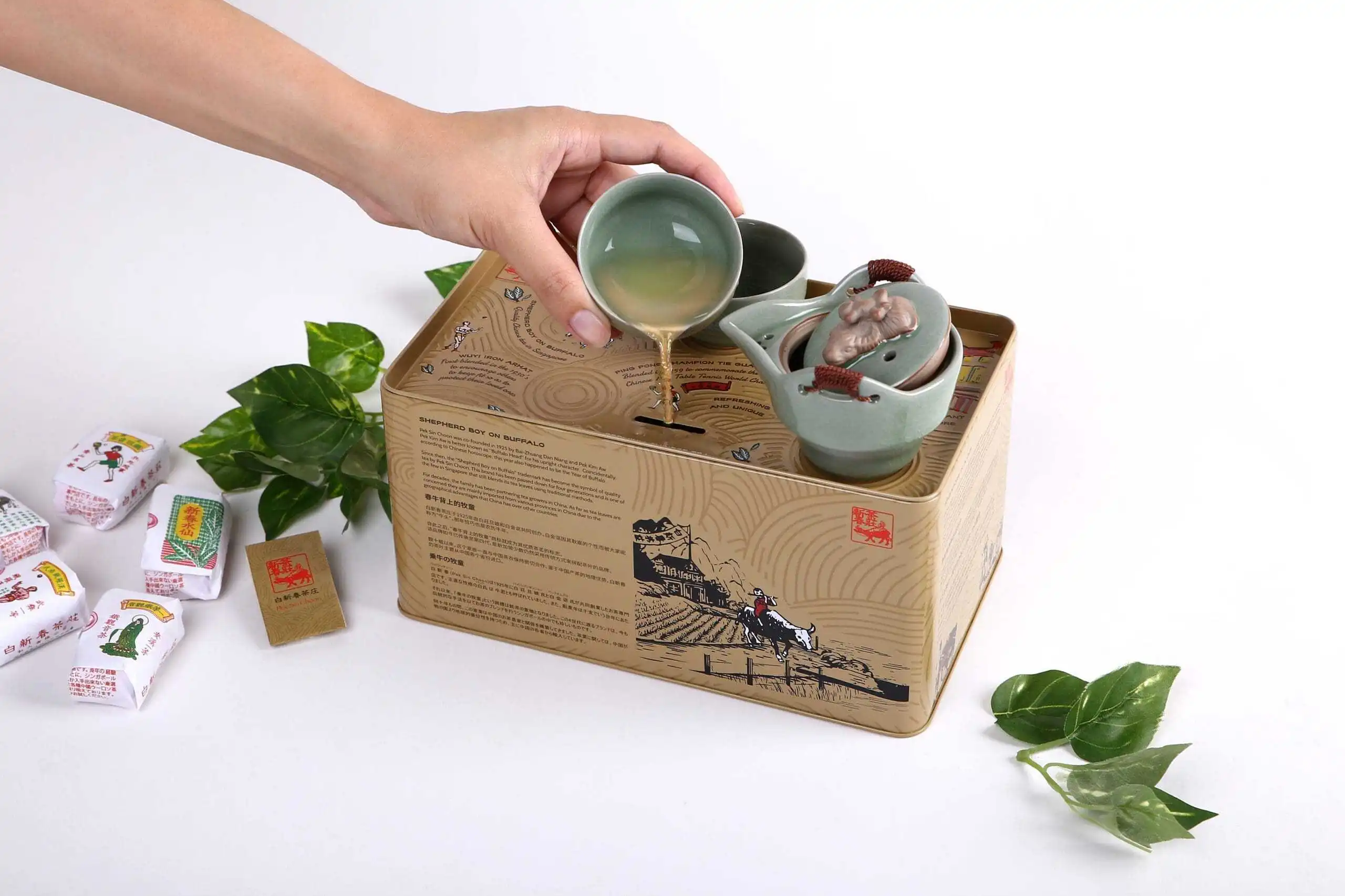
Creativeans began with a brand audit and repositioned Pek Sin Choon from a functional tea merchant into a symbolic and experiential heritage brand rooted in Chinese tea culture.
The refreshed identity blended nostalgic elements with a contemporary design language. Illustrated mascots and graphic components were derived from the company’s legacy rather than added as arbitrary decoration.
The strategy then moved into the customer experience.
The Heritage Portable Tea Brewing Set simplified Chinese tea preparation for modern users. Clear instructions made the ritual more approachable, while the packaging, brochures, point-of-sale materials and vehicle graphics reinforced a consistent identity across the brand’s touchpoints.
An AI tool could create attractive vintage Chinese tea packaging.
It could not independently determine:
- Which parts of Pek Sin Choon’s history carried the most meaning
- How far the identity could be modernised without losing authenticity
- How tea preparation could become more accessible
- How heritage should be translated across products and experiences
- Which creative decisions would respect both existing customers and future audiences
The defensible value was not the presence of nostalgic illustrations.
It was the strategic connection between real heritage, customer insight, cultural meaning, product experience and contemporary execution.
That connection belonged specifically to Pek Sin Choon. A competitor could imitate the aesthetic, but it could not claim the same story with the same credibility.
Your Brand Is Not the Asset. It Is the System Behind the Asset.
The title of this article requires one important clarification.
Logos can be copied.
Colours can be copied. Packaging structures can be copied. Website layouts can be copied. Tone-of-voice prompts can be copied. Competitors may even imitate your campaigns or repeat your positioning language.
What is much harder to copy is a coherent brand system built from:
- A specific organisational history
- A focused market position
- Consistent founder conviction
- Proprietary expertise
- Recognisable behaviour
- Customer relationships
- Operational proof
- Repeated experiences over time
A competitor may reproduce one visible element. It cannot reproduce the entire chain of decisions and experiences that gave the element meaning.
That is why brand-building remains essential in the age of AI.
As production becomes easier, judgment becomes more valuable.
As polished content becomes abundant, clarity becomes more valuable.
As visual styles become easier to imitate, authenticity and consistency become more valuable.
And as customers encounter more competent-looking options, the businesses that stand for something specific become easier to choose.
Five Questions for Founders
Before generating another campaign, logo variation or batch of social media content, ask:
- Can customers explain why they should choose us without mentioning price?
- Are we communicating a position competitors cannot make just as credibly?
- Does our identity express something true about the business?
- Is our brand promise visible in the customer experience?
- Are we using AI to strengthen our brand system—or to replace it with more content?
When the answers are unclear, the company probably does not have a design problem.
It has a brand clarity problem.
Build the Part of Your Business That AI Cannot Replicate
AI should be part of the modern branding process.
It can accelerate research, organise information, explore directions, produce adaptations and help teams maintain consistency at scale. Used well, it gives strategists and designers more time to focus on the decisions that matter.
But it must work inside a clear brand strategy.
Without that foundation, AI simply helps a company produce generic work faster.
Creativeans is an award-winning brand and design consultancy based in Singapore, Milan and Jakarta. Since 2012, its consultants have helped businesses develop brands through a systematic, interdisciplinary approach spanning strategy, identity, experience, communication and implementation.
A founder-led brand consultation can help identify where your brand is becoming interchangeable, what customers genuinely value and which position your competitors cannot easily take from you.
Because in the age of unlimited generation, the advantage does not belong to the business producing the most content.
It belongs to the business with the clearest reason to exist.
Frequently Asked Questions
Can AI create a complete brand?
AI can help create components of a brand, including names, logos, colour palettes, copy and content templates. However, a complete brand also requires research, positioning, organisational decisions, customer experience and consistent implementation. These areas require human judgment and business commitment.
What makes a brand difficult to copy?
A brand becomes difficult to copy when its visual identity, messaging, products, service experience and organisational behaviour all reinforce a specific position. Individual assets may be imitated, but the complete system and the credibility behind it are much harder to reproduce.
How can businesses avoid generic AI branding?
Begin with customer and competitor research before generating creative assets. Define a focused position, establish clear verbal and visual principles, give AI specific brand context and require human review. Do not allow the tool’s default output to become your company’s identity.
Is brand strategy still important when AI can generate designs?
Brand strategy becomes more important because design production is becoming easier. When many businesses can produce professional-looking materials, strategy determines whether those materials communicate a meaningful and memorable difference.
When should a company review or refresh its brand?
A brand review may be necessary when customers struggle to understand the company, the business has entered new markets, competitors have become difficult to distinguish from, the identity no longer reflects the company’s capabilities, or marketing increasingly depends on discounts and paid visibility.




 INSIGHTS